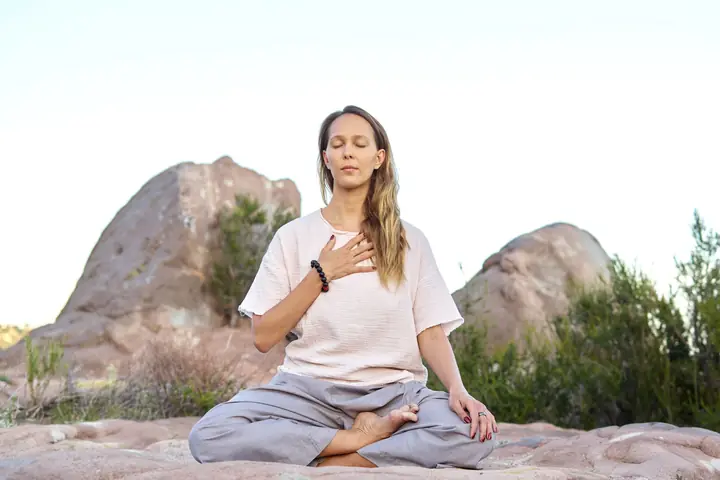
Quick take
- Breathe through your nose, let your belly and lower ribs move, and make your exhale a little longer than your inhale.
- About 5 to 6 breaths a minute for 5 minutes is a simple, well-studied way to calm down.
- Stay comfortable. If you feel dizzy or short of air, go back to normal breathing.
Try it now
Sit or lie comfortably, let your shoulders drop and breathe through your nose if you can. Pick a mode below. Start with "even" or "long" and follow the pacer for 2 to 5 minutes. Do not force the breath to fit; if a count feels too long, breathe a little less deeply rather than straining.
When you finish, sit for a few breaths without counting and notice how you feel. Most people notice their shoulders lower, their thoughts slow a little, and their breathing stays slower on its own for a while.
Belly and rib breathing
Your main breathing muscle is the diaphragm, a dome under your lungs. When it contracts it flattens downward, your belly moves out and your lower ribs widen. When you are stressed or slumped, breathing tends to move up into the chest and shoulders, which is faster and shallower.
Get set
Lie on your back with knees bent and feet on the floor, or sit tall in a chair. Put one hand on your belly and one on the side of your lower ribs.
Breathe low
Inhale through your nose and let the belly hand rise first. Do not push the belly out; just allow it to move.
Add the ribs
Keep inhaling and feel the rib hand move out to the side, like an umbrella opening slightly.
Let it go
Exhale slowly through your nose and let everything fall back. Repeat for 10 breaths.
You do not need to breathe this way all day. The aim is to know what a relaxed, low breath feels like so you can return to it when you notice yourself tensing up.
Nose breathing
Breathing through your nose naturally slows the breath, because the nose has more resistance than the mouth. It also warms and humidifies the air. For gentle yoga and calming practices, nose breathing is the default.
If your nose is blocked, breathe through your mouth with soft lips and simply keep the breath slow. During harder effort, such as holding Chair Pose for a long time, it is fine to exhale through the mouth. Treat nose breathing as a default you return to, and let it go when you need more air.
Breathing during poses
The breath is your best gauge of effort. If you can breathe slowly and evenly through your nose, the pose is at the right intensity. If you are holding your breath or gasping, ease off.
Simple pairing rules
- Inhale when you lift, lengthen, open the chest or arch the back: rising in Halfway Lift, the cow half of Cat-Cow, lifting into Cobra Pose.
- Exhale when you fold, round, twist or lower: folding into Standing Forward Fold, the cat half of Cat-Cow, turning in Supine Twist.
- In a held pose, breathe normally through the nose and use each exhale to release unnecessary tension in your jaw, shoulders and hands.
Count breaths rather than seconds when you hold a pose. Five slow breaths is roughly 30 to 45 seconds, and counting keeps you from holding your breath without noticing.
Four breathing patterns
Longer exhale
Breathe in for a count of 4 and out for a count of 6. This is the "long" mode on the pacer. Making the exhale longer than the inhale is a simple way to tilt toward calm, and it is the easiest pattern to use anywhere: on a train, before a meeting, in bed.
Box breathing
Inhale for 4, hold for 4, exhale for 4, hold for 4. This is the "box" mode. The even, square rhythm gives a busy mind something to follow. If the holds feel uncomfortable, shorten them to 2 counts or drop them and keep the 4-count inhale and exhale.
4-7-8 breathing
Inhale through the nose for 4, hold for 7, exhale slowly through the mouth for 8. This is the "478" mode. Many people use it to wind down before sleep. Do 4 rounds, then return to normal breathing. Because the hold and exhale are long, it can make you lightheaded at first. Count faster if you need to; the ratio matters more than the clock.
Slow paced breathing
Breathe at about 5 to 6 breaths a minute, around 5 seconds in and 5 seconds out, with no holds. This is the "even" mode. It is sometimes called coherent or resonance breathing, and it is the pattern with the most research behind it. Try 5 minutes once or twice a day, or use it inside the Stress Reset routine.
| Pattern | Counts | Good for |
|---|---|---|
| Longer exhale | 4 in, 6 out | Quick calm, anywhere |
| Box | 4 in, 4 hold, 4 out, 4 hold | Focus when your mind is racing |
| 4-7-8 | 4 in, 7 hold, 8 out | Winding down before bed |
| Slow paced | About 5 in, 5 out | A daily 5-minute practice |
Building a habit
Pick one pattern and one moment of the day, and attach the practice to something you already do: after brushing your teeth, before opening your laptop, or once you are in bed. Two to five minutes is plenty. After a week, most people find the slower rhythm comes back more easily when they need it, such as in traffic or before a difficult conversation. You can also add one minute of slow breathing at the start of any routine, like the Desk Break Routine, to help you shift out of work mode.
What the research says
Slow breathing has been studied quite a lot, and the overall picture is encouraging but modest. Studies suggest that breathing at around 6 breaths a minute can shift heart rate variability in a direction associated with relaxation, and that short daily practice can help people feel less stressed and anxious. Some studies also report small reductions in blood pressure.
The limits are worth stating plainly. Many studies are small and short, they compare different techniques in different ways, and it is hard to run a truly "blind" breathing trial. Public summaries such as those from the NCCIH make a similar point: the results for stress are promising, and larger, better-designed studies are still needed. Breathing exercises are a useful tool for feeling calmer. They are not a treatment for anxiety disorders, heart disease or high blood pressure, and should not replace care you already receive.
There is less evidence that one specific count, like 4-7-8, is better than another. Slow, comfortable, and regular seems to matter more than the exact numbers.
Cautions
- Dizziness or tingling in your fingers or face usually means you are breathing too deeply or too forcefully. Stop the pattern, breathe normally and let it pass. Next time, take smaller breaths.
- Never strain. If a count feels too long, shorten it. Air hunger means back off.
- Breath holds (box and 4-7-8) are best skipped during pregnancy, and if you have a heart condition, uncontrolled high blood pressure, or a lung condition such as COPD, unless your doctor or midwife has said they are fine. The longer-exhale and slow paced patterns without holds are gentler choices.
- If breathing exercises make you more anxious, which happens to some people, especially with panic, try keeping your eyes open, counting less, or doing gentle movement like Cat-Cow with the breath instead.
- Do not practice breath holds while driving, in water, or anywhere fainting would be dangerous.