Quick take
- Using a prop is the smart way to practice. It lets you keep good alignment while your body adapts.
- Two thick books, a belt, a folded blanket, a firm cushion, a sturdy chair and a clear wall cover almost everything.
- Below the props section you will find swaps for six common limitations, with links to each pose.
Your prop kit
You do not need to buy anything to start. Here is what each prop does and what to use if you do not own the real thing. For buying advice, see What You Need (and Don't).
Blocks (or books)
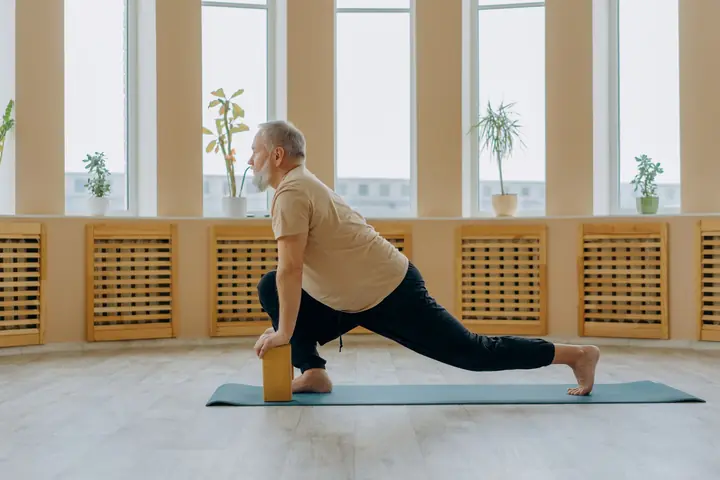
A block raises the floor. Put one under each hand in Standing Forward Fold, Low Lunge or Triangle Pose so you can keep your back long instead of rounding to reach down. A block has three heights: flat, on its side and standing tall. Two hardcover books of similar size work just as well. Stack them and wrap them with a rubber band so they do not slide.
Strap (or belt)
A strap makes your arms longer. Loop it around your foot in Reclined Hamstring Stretch or Seated Forward Fold so you can keep your spine and shoulders relaxed. A bathrobe belt, a long scarf or a dog leash without the clip all work. Hold it loosely, the way you would hold a bicycle handlebar.
Blanket
A firm blanket folded into a rectangle about 5 cm (2 in) thick is the most versatile prop you can own. Sit on it to tilt your pelvis forward in seated poses. Fold it thinner to pad your knees. Roll it to place under your knees in Corpse Pose. Put it over you during rest.
Cushion
A firm sofa cushion or bed pillow is softer than a blanket and good for resting on. Use it under your forehead in Child's Pose, under your head in Thread the Needle, or between your heels and hips if kneeling is uncomfortable.
Chair
Use a sturdy chair without wheels, with its back against a wall so it cannot slide. A chair can replace the floor entirely (see Chair Yoga), give you something to hold for balance, or raise your hands in poses like Downward Dog and Puppy Pose.
Wall
The wall is free and never wobbles. Stand near it for balance poses, put your hands on it for a gentler Downward Dog, rest your back foot against it in lunges, or put your legs up it for Legs Up the Wall.
Tight hamstrings
Tight hamstrings pull on the pelvis and make your lower back round in any forward bend. The fix in almost every case is to bend your knees and raise the floor.
| Pose | Swap or setup |
|---|---|
| Standing Forward Fold | Bend knees generously, hands on blocks or on your shins. |
| Downward Dog | Bend knees and lift heels high so your back stays long. Or do it with hands on a chair seat. |
| Seated Forward Fold | Sit on a folded blanket, knees bent, strap around your feet. |
| Triangle Pose | Shorten your stance by a foot length, bottom hand on a tall block. |
| Reclined Hamstring Stretch | Use this as your main hamstring stretch. Your back stays supported on the floor. |
Sensitive knees
Knees usually complain about two things: direct pressure on the kneecap, and deep bending under load. Pad the first and limit the second.
- Kneeling poses such as Cat-Cow, Bird Dog and Low Lunge: double your mat or put a folded blanket under the knees. If kneeling still hurts, do Cat-Cow seated on a chair and replace Low Lunge with High Lunge, hands on a chair.
- Child's Pose: put a cushion between your calves and thighs so the knees bend less. Or lie on your back and do Knees to Chest instead.
- Pigeon Pose: swap for Figure Four on your back. It stretches the same hip without twisting the front knee.
- Standing lunges and Warrior Two: keep the front knee over the ankle, pointing the same way as your toes, and bend less deeply.
- Chair Pose: sit back only as far as is comfortable, or use a wall behind you.
Wrists
Weight-bearing poses can be hard on wrists, especially if you type all day. Spread the load and change the angle.
- Spread your fingers wide and press through the knuckles at the base of the index finger and thumb so the heel of your hand is not doing all the work.
- Roll the front edge of your mat or a thin towel and put it under the heels of your hands. This reduces how far the wrist bends back.
- Make fists, or hold blocks, so your wrists stay straight in Cat-Cow and Plank Pose.
- Drop to your forearms: forearm plank instead of Plank, Sphinx Pose instead of Cobra Pose, Puppy Pose instead of Downward Dog.
- Use the wall: hands on the wall at shoulder height turns Downward Dog and Plank into standing poses with very little wrist load.
Lower back
For a stiff or sensitive lower back, the general rule is to keep your spine long and supported, move slowly, and avoid strong loaded rounding. Pain that is mild and familiar usually tolerates gentle movement well. New or severe pain should be checked by a professional first.
| Instead of | Try | Why |
|---|---|---|
| Standing Forward Fold | Halfway Lift with hands on a chair or wall | Keeps the back flat while the hamstrings stretch. |
| Seated Forward Fold | Reclined Hamstring Stretch | The floor supports your back. |
| Boat Pose | Bird Dog | Core work without loading the spine in a rounded shape. |
| Cobra Pose | Sphinx Pose | A smaller, easier-to-control backbend. |
| Seated Twist | Supine Twist with a cushion under the knees | Gravity does the work and you can control how far you go. |
When getting up from lying down, roll onto your side first and push up with your arms. The Lower Back Relief routine is built around these gentler choices.
Getting down to the floor, and balance
If the floor is hard to reach
Plenty of people find getting down and up again slow or unsafe. You can do a complete practice without the floor at all.
- Do your practice in a chair. Chair Yoga covers seated versions of twists, side bends, hip openers and forward folds.
- Bring floor poses up to a bed: Knees to Chest, Figure Four, Supine Twist and Bridge Pose work on a firm mattress.
- Replace all-fours poses with standing ones: hands on a counter or chair back for Cat-Cow and Puppy Pose.
- If you do want to practice getting down, use a chair beside you: hand on the seat, lower one knee to a cushion, then the other, then your hands. Reverse to come up.
Balance
Balance improves with practice, and practicing safely means having support within reach.
- Stand beside a wall or the back of a chair for Tree Pose, High Lunge and Warrior Two. Touch it lightly with your fingertips.
- In Tree Pose, put your foot at the ankle with toes on the floor before trying the calf. Never press the foot into the side of the knee.
- Widen your stance in lunges, as if your feet are on two railway tracks rather than a tightrope.
- Look at a fixed point on the floor 1 to 2 meters in front of you.
- Practice barefoot on a non-slip surface. Socks on a wooden floor are a common cause of slips.