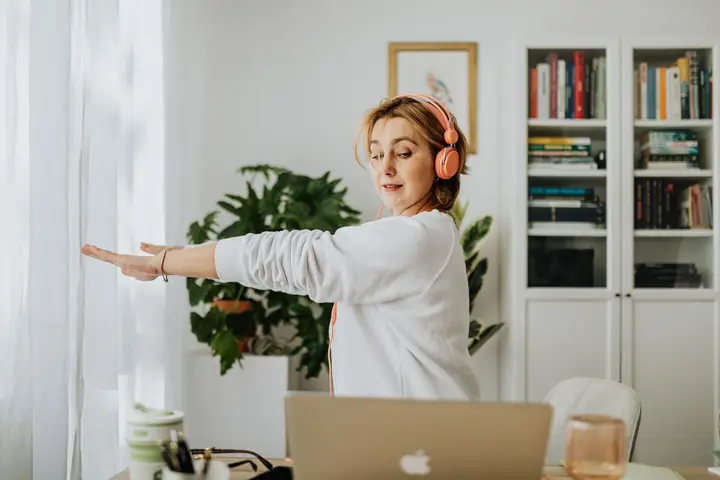
Quick take
- For anyone who sits at a screen for hours and feels it in the neck, shoulders, upper back or hips.
- You should feel looser between the shoulder blades and more upright when you sit back down.
- Do it mid-morning and mid-afternoon, or whenever you notice yourself leaning toward the screen.
The routine
Push your chair back from the desk so your knees are clear and both feet sit flat on the floor. If the chair has wheels, lock them or swap to a fixed chair. Sit near the front edge of the seat for the seated part, so your spine is not leaning on the backrest.
- Seated Mountain 30 sec Feet flat, knees over ankles, the crown of your head rising toward the ceiling. Take three slow breaths and look away from the screen at something across the room.
- Shoulder rolls 30 sec Lift your shoulders toward your ears, roll them back and let them drop down. Go slowly, about five seconds per circle, then reverse for the last few.
- Seated neck stretch 30 sec each side Hold the edge of the seat with your right hand and tip your left ear toward your left shoulder. Feel the right side of your neck lengthen, and let the weight of your head do the work instead of pulling.
- Seated Cat-Cow 45 sec Hands on your knees: inhale to lift your chest and draw the shoulder blades together, exhale to round your back and look at your belt. Let the movement start low in the spine.
- Chair Twist 30 sec each side Sit tall, put your left hand on your right knee and your right hand on the back of the chair, and turn right. Keep both knees pointing forward so the twist happens in your ribs, not your hips.
- Seated Side Bend 30 sec each side Rest your left hand on the seat and reach your right arm up and over to the left. Press your right sitting bone down so the stretch runs from your waist into your armpit.
- Chest opener 30 sec Shift forward, lace your fingers behind your back, or hold the sides of the seat, and draw your knuckles down and away. Lift your breastbone a little and keep your chin level.
- Seated Figure Four 30 sec each side Cross your right ankle over your left knee and flex the foot. Stay upright, or hinge forward from the hips with a long back until you feel the outer right hip.
- Desk dog 45 sec Stand, put your hands shoulder-width on the desk edge and walk your feet back until your arms and back form one long line. Let your chest sink toward the floor and keep your knees soft.
- Wrist and finger stretch 30 sec Stretch your right arm forward, palm up, and use your left hand to ease the fingers down and back for a few breaths, then switch. Finish by spreading and shaking out both hands.
- Mountain Pose 30 sec Stand tall, feet hip-width, arms relaxed. Close your eyes or soften your gaze, take three full breaths and notice where your shoulders sit now.
Why these poses
Long stretches of screen work tend to produce the same shape: head forward, shoulders rounded, upper back still for hours, hips folded at 90 degrees. This routine works on each part of that shape in turn, from the top down, and then gets you standing.
The first three steps target the neck and shoulders, where most desk workers notice stiffness first. Shoulder rolls warm the area with movement before you hold anything, and the neck stretch comes after, once the muscles are a bit warmer. Seated Cat-Cow then moves the whole spine in both directions, which is often what a stiff back wants more than any single stretch.
The twist and side bend take the spine in the two directions you almost never move it at a desk. The chest opener counters the rounded-shoulder posture of typing. Seated Figure Four reaches the outer hips, which tighten from sitting and can contribute to an achy lower back.
Desk dog is the one standing stretch. It lengthens the back of the body and the shoulders at the same time without getting on the floor. Wrists get their own step because mouse and keyboard work keeps them bent in one direction all day. A final standing breath resets your posture before you sit again.
Make it easier or harder
Easier
- Tight skirt or trousers: swap Seated Figure Four for crossing your legs normally at the knee and hinging forward a little.
- Shared office and short on privacy: keep the shoulder rolls, neck stretch, twist and wrist stretch. Nobody will notice those.
- Shoulders too tight to clasp behind you: hold the back edges of the seat for the chest opener instead.
Harder
- Hold desk dog for a full minute and step one foot further back to stretch that calf.
- Add 30 seconds of Chair Pose before the last Mountain Pose to wake up the legs.
Questions
How often should I do this during a workday?
Twice is a good target, once mid-morning and once mid-afternoon. Short breaks to stand and move every 30 to 60 minutes matter at least as much as the routine itself.
Can I do it on a chair with wheels?
Lock the wheels or brace your feet so the chair cannot roll during the twist and the forward hinge. If it still slides, use a fixed chair from a meeting room.
Will this fix my posture?
It can relieve stiffness and remind you what upright feels like, but posture is mostly about how long you hold one position. A better screen height and regular breaks help as much as any stretch.