Quick take
- For everyday lower back stiffness: the ache after a long drive, a day at a desk or a weekend in the garden.
- You should feel the back loosen and warm up, with gentle stretch sensations and no sharp pain.
- Do it in the evening, or any time the back feels tight. Small and regular beats long and rare.
The routine
Most of this routine happens on your back, where the spine is supported and nothing has to work hard to hold you up. Move at half the speed you think you need. If a pose increases your pain, back off to a smaller version or skip it, and keep going with the rest.
- Constructive rest 1.5 min Lie on your back with knees bent, feet flat and wider than your hips, and let your knees lean in to touch. Breathe into your belly and feel your lower back settle toward the floor without pressing it there.
- Pelvic tilts 1 min Feet hip-width now. On an exhale, gently flatten your lower back into the floor, then on the inhale let a small arch return, rocking your pelvis like a bowl tipping back and forth.
- Knees to Chest 1 min Bring one knee in, then the other, holding behind the thighs if your knees dislike being squeezed. Make slow circles with your knees together to massage the lower back against the mat.
- Reclined Hamstring Stretch 45 sec each side Keep the left foot on the floor with the knee bent, loop the strap around your right foot and lift the leg until you feel the back of the thigh. A bent knee is fine; keep your lower back resting down.
- Figure Four 45 sec each side Cross your right ankle over your left thigh, foot flexed. Stay with the left foot down, or draw the left knee toward you until the outer right hip and buttock stretch.
- Supine Twist 45 sec each side Lower both bent knees slowly to the left, only as far as is comfortable, with a pillow under them if needed. Keep both shoulders heavy and breathe into the right side of your back.
- Cat-Cow 1 min Roll to your side and come onto hands and knees, blanket under the knees. Move through a small range, lifting and dropping the chest, and keep the motion smooth and pain-free.
- Bird Dog 30 sec each side Slide your right leg back along the floor and lift it to hip height, adding the left arm forward if steady. Keep your hips level, as if a cup of tea sits on your lower back, and return and repeat slowly.
- Sphinx Pose 1 min Lie on your belly with elbows under your shoulders and forearms parallel. Let your belly soften on the floor; if your lower back pinches, slide your elbows forward to lower your chest.
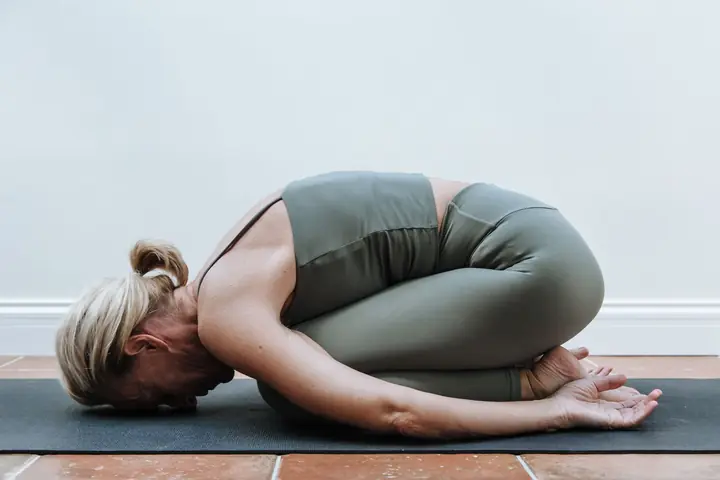
- Child's Pose 1 min Press back to sit toward your heels, knees wide, forehead on your hands or a pillow. Breathe into the lower back and feel it widen.
- Bridge Pose 1 min On your back, feet hip-width and close to your hips, peel your hips up a few centimeters on an inhale and lower on the exhale. Lift only as high as stays comfortable, five or six times.
- Corpse Pose 2 min Put a pillow or rolled blanket under your knees and let your legs and arms go heavy. Notice how your lower back meets the floor now compared with the first minute.
Why these poses
Everyday back stiffness often has less to do with the back itself than with what surrounds it. Tight hamstrings, hips and hip flexors pull on the pelvis, and weak or switched-off deep core muscles leave the lower back doing extra work. This routine touches each of those, gently.
The first three steps are the warm-up. Constructive rest lets the back muscles stop guarding, pelvic tilts add the smallest possible movement, and Knees to Chest adds a mild stretch. Starting on your back keeps the load off your spine while it warms up.
The middle section stretches the neighbors. The hamstring stretch and Figure Four release the backs of the legs and the outer hips, and the twist adds gentle rotation. Then you turn over: Cat-Cow moves the spine, and Bird Dog asks the core muscles that support the back to switch on without any strain. Research on chronic low back pain generally supports staying active and doing gentle, regular exercise over long rest, and yoga is one of the approaches the NCCIH notes has some evidence behind it.
Sphinx offers a mild backbend, which many people with a sitting-stiff back find relieving. Child's Pose balances it with a fold. Bridge strengthens the glutes, and Corpse Pose gives you two minutes to let the work settle.
Make it easier
- Getting up and down is hard: skip the hands-and-knees and belly poses and do only steps 1 to 6, then Bridge and Corpse Pose. That is about eleven minutes on your back.
- Sphinx pinches: lie flat on your belly with your forehead on your hands instead.
- Knees are sore on all fours: double the blanket, or swap Bird Dog for extra pelvic tilts.
- The twist feels like too much: lower your knees only halfway and rest them on a pillow.
Build it up over time
Once the routine feels easy for a week or two, hold Bird Dog for three breaths per rep and lift Bridge higher for five-breath holds. Those two poses build the strength that tends to keep everyday stiffness away. Leave the stretches gentle.
Questions
Should I do this when my back is really sore?
For ordinary stiffness, gentle movement usually feels better than lying still all day. Use the smallest versions and the on-your-back section only. If the pain is severe or comes with any of the warning signs above, see a professional first.
How often should I do it?
Daily is fine, and three or four times a week is enough to notice a difference for many people. Consistency matters more than session length.
Why no forward folds or deep backbends?
Deep standing folds load the lower back heavily, and strong backbends can aggravate some back problems. This routine keeps everything mild so it is safe to repeat on a bad day.
When should I expect it to feel better?
Many people feel looser straight after a session. Lasting change in everyday stiffness usually takes a few weeks of regular practice. If pain is not improving after several weeks, get it checked.