Quick take
- For people who already know the basic poses and want a session that works the muscles, not just stretches them.
- You will feel your abdominals, glutes, thighs and the muscles along your spine working. Shaking near the end of a hold is normal.
- Two or three times a week, on non-consecutive days. Morning or early evening; it is too energizing for right before bed.
The routine
Fifteen steps in three parts: a warm-up on hands and knees, a standing block for legs and balance, and a floor block for the front and back of the trunk. Rest in Child's Pose whenever you need to; it is better to pause than to hold a pose with a sagging lower back.
- Cat-Cow 1 min Move with the breath, and on every exhale draw your navel gently toward your spine. That light tension is the feeling you want to find again in every pose that follows.
- Bird-Dog 45 sec each side Reach the opposite arm and leg long, hips level, as if a glass of water sits on your lower back. For the last 15 seconds, draw elbow to knee under you and reach out again, slowly.
- Downward Dog 1 min Press the floor away with your hands and lift the hips high. Pedal the feet for a few breaths, then hold still.
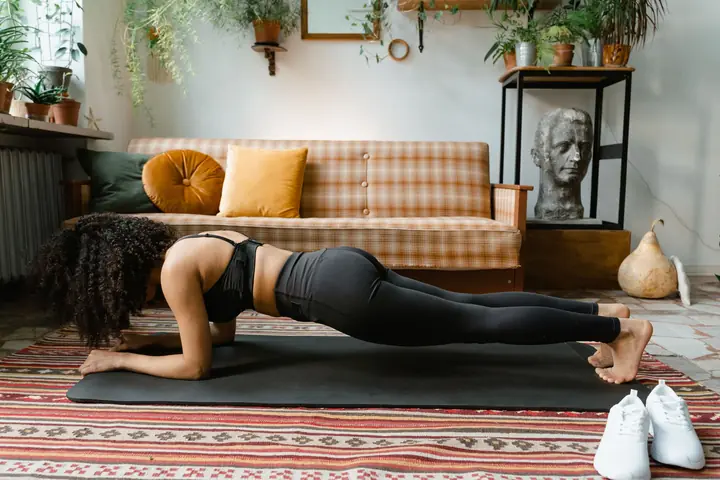
- Plank Pose 1 min Shoulders over wrists, body in one line from head to heels, front ribs drawn in. Lower to your knees at any point and keep the same straight line from knees to head.
- Chair Pose 1 min Walk to the front of the mat, feet together or hip-width, and sit back as if onto a high stool. Weight in the heels, arms up by the ears, and hold for three slow breaths, stand, then repeat twice.
- High Lunge 45 sec each side Step one foot back, back heel lifted, front knee over the ankle. Arms up, and squeeze the back thigh up so the back knee stays off the floor.
- Warrior Two 1 min each side Front knee bent over the ankle, back foot angled in, arms reaching in opposite directions. Sink until the front thigh burns, then press the outer edge of the back foot down to keep the stance solid.
- Goddess Pose 1 min Feet wide, toes turned out, knees bent over the toes. Pulse up and down a few inches for 30 seconds, then hold the low position.
- Tree Pose 30 sec each side Press the foot into the inner calf or thigh, never the knee, and press the leg back into the foot. Steady your gaze on one point and keep the standing hip from jutting out.
- Plank Pose 1 min Back on the floor and into plank again. This time, tap one shoulder with the opposite hand, slowly, keeping the hips from rocking.
- Locust Pose 1.5 min Lie on your belly, arms by your sides, and lift your chest, arms and legs a few inches. Hold for five breaths and lower; do three rounds in total.
- Child's Pose 30 sec Knees wide, hips back to the heels, forehead down. Let your lower back round and rest after the back-strengthening work.
- Boat Pose 1.5 min Sit up, lean back with a long spine and lift your shins parallel to the floor. Hold for five breaths, rest, and repeat for three rounds; keep the chest lifted rather than rounding.
- Bridge Pose 1.5 min Lie back, feet under your knees, and lift the hips by pressing through your heels. Squeeze a block or cushion between your knees, hold for five breaths and lower; three rounds.
- Supine Twist 30 sec each side Knees bent, let them fall to one side with arms wide. Let your belly soften completely after all that bracing.
- Corpse Pose 2 min Lie flat and still. Feel the warmth in your legs and trunk and let your breathing slow down on its own.
Why these poses
Your core is more than the abdominal wall. It includes the deep muscles that brace the spine, the back muscles, the glutes and the muscles around the pelvis. This flow works all of them, in an order that warms up first, builds load gradually and ends by releasing the muscles you just worked.
Cat-Cow and Bird-Dog teach the bracing pattern on hands and knees, where it is easy to feel and hard to get wrong. Bird-Dog in particular trains the trunk to resist rotation while your limbs move, which is how the core works most of the time in daily life.
Downward Dog and the first plank transfer that bracing to a heavier position. The standing block then builds leg strength: Chair Pose and Goddess load the thighs and glutes, High Lunge and Warrior Two hold them in longer, wider stances, and Tree Pose asks your hips and ankles to stabilize on one leg.
The floor block covers what standing work misses. The second plank, with shoulder taps, adds anti-rotation. Locust strengthens the back of the body, Boat the front, and Bridge the glutes and hamstrings. Child's Pose, the twist and a full two minutes of rest let the trunk relax and the heart rate settle.
Make it easier
- Drop the knees in both planks. Keep a straight line from knees to head.
- Keep hands on the floor in Boat behind your hips, or hold the backs of your thighs with your feet down.
- Lift only the chest in Locust, or only the legs, rather than both at once.
- Hold for fewer breaths and rest between rounds. Good form for three breaths beats poor form for ten.
Make it harder
- Straighten the legs in Boat, or lower down halfway and lift back up on each exhale.
- Lift one leg in Bridge for the last round, 15 seconds each side.
- Twist in Chair Pose: palms together, hook one elbow outside the opposite knee for a breath on each side.
- Run the whole sequence twice with a shorter rest at the end for a 35-minute session.
Questions
Is this enough strength training on its own?
It builds useful strength, especially for beginners and in the trunk. Bodyweight holds have limits, though. If you want to keep progressing, current activity guidelines suggest muscle-strengthening work for all major muscle groups at least twice a week, and adding weights or resistance bands is a sensible next step.
My wrists hurt in plank. What can I do?
Spread your fingers wide and press through the knuckles at the base of each finger so the weight is not all in the heel of the hand. Forearm plank is a good substitute: elbows under shoulders, forearms parallel.
Should my stomach muscles be sore the next day?
Mild soreness after the first few sessions is normal. Sharp pain or soreness that lasts more than a few days suggests the load was too much, so ease off and use the easier options.
Can I do this every day?
Muscles need time to recover. Two or three sessions a week, with a gentler routine on the days in between, works better than daily strength work.