Quick take
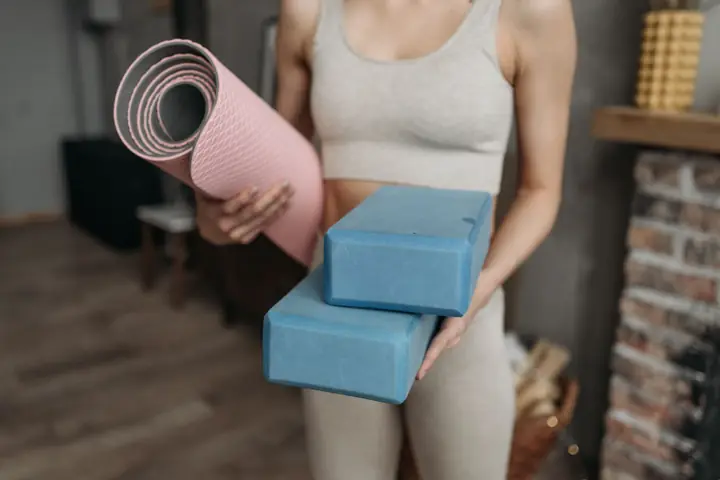
- Buy first: a mid-weight mat with good grip. Everything else can come from around the house.
- Books replace blocks, a belt or scarf replaces a strap, a folded blanket replaces a bolster.
- Skip special clothing, gadgets and anything sold as a "kit". You can start for nothing and be fully set up for little.
Home yoga needs very little equipment, and most of what helps is already in your home. Props matter more than people expect, though. A book under your hand or a blanket under your knees is often the difference between a pose that strains and one you can breathe in. This page goes through each item, what it does, what to look for, and what to use instead.
The mat
A mat does three jobs: it stops your hands and feet from sliding, it cushions knees and wrists, and it marks out your practice space. Grip is the most important of the three. A mat that lets your hands creep forward in Downward Dog makes the pose tiring and can strain your shoulders.
Thickness
| Thickness | Feels like | Good for |
|---|---|---|
| Thin (1.5 to 3 mm) | Firm, close to the floor, light to carry | Travel, carpeted floors, standing and balance work |
| Standard (4 to 6 mm) | Some cushion, still stable underfoot | Most people on most floors; the safe first choice |
| Thick (8 mm and up) | Soft and springy | Sensitive knees, floor-heavy gentle routines; less stable in balance poses |
If you are unsure, pick around 5 mm. If your knees are sensitive, keep a standard mat and fold a towel under them for kneeling poses. That gives cushion where you need it without making standing poses wobbly.
What to look for
- Grip when dry and slightly damp. Press your palm into it and slide; it should hold. Natural rubber and textured surfaces usually grip best. Very smooth, shiny surfaces tend to get slippery once your hands warm up.
- Size. Standard mats are about 68 by 24 inches (173 by 61 cm). If you are taller than about 6 feet (183 cm), look for a long version so your head and feet both fit in Corpse Pose.
- Density. Press a thumb in hard. If you feel the floor immediately, it is too soft or too thin for kneeling.
- Smell and materials. Some cheap foam mats smell strongly at first. Air it out for a few days. If you have a latex allergy, avoid natural rubber.
Mat care
Wipe it with a damp cloth and a drop of mild dish soap after sweaty sessions, then let it air dry before you roll it up. Keep it out of direct sun, which breaks down rubber. Avoid oils and strong cleaners, which make most surfaces slippery.
Props and their household stand-ins
Props bring the floor closer, support your weight or extend your reach. Using them is how you get a pose to fit your body, and experienced students use them as much as beginners do. The Props & Modifications page shows exactly where they go in each pose.
Blocks
Blocks go under your hands in folds and lunges when the floor is too far away, under your hips in Bridge Pose for a supported version, or under your sit bones in kneeling poses. Two are more useful than one. Foam blocks are light and soft on the hands; cork and wood are firmer and heavier.
Instead: two thick hardback books of the same size, a sturdy shoebox, or a stack of magazines taped together. Keep them stable: no slippery covers, nothing that can tip over when you lean on it.
Strap
A strap lengthens your arms. Loop it around your foot in the Reclined Hamstring Stretch or Seated Forward Fold so you can keep your back long instead of rounding to reach your toes. It also helps with shoulder stretches where your hands cannot meet.
Instead: a belt, a dressing-gown cord, a long scarf, a tie or a rolled towel. Anything about 6 feet (1.8 m) long that does not stretch.
Blanket
Probably the most useful prop of all. Fold it to sit on in Easy Seat so your knees can drop below your hips, put it under your knees when kneeling, roll it under your knees in Corpse Pose, or cover yourself with it for the final rest.
Instead: any firm blanket or a couple of bath towels. Avoid thick, fluffy duvets, which collapse when you sit on them.
Cushion or bolster
A firm cushion supports you in rest and gentle poses: under your chest in Child's Pose, under one hip in Pigeon Pose, or under your knees on your back. A bolster is just a long, firm cushion made for this.
Instead: a couch cushion, a firm bed pillow, or two blankets rolled together and held with a belt.
A chair and a wall
Two of the most useful props are already part of your home. A sturdy chair without wheels or arms lets you do a full practice seated (see Chair Yoga), gives you something to hold in balance poses, and works as a high block in standing folds. Put it against a wall so it cannot slide.
A clear stretch of wall is good for balance support in Tree Pose, for chest and shoulder stretches, and for Legs Up the Wall, one of the most restful poses there is. Lay your mat at right angles to the wall when you want to use it.
Clothes and space
Clothing
Wear what lets you bend, lunge and lie on your back without adjusting it. That usually means leggings, shorts or soft trousers, and a top that stays put when you fold forward. Very loose tops slide up over your face in Downward Dog; tuck them in or pick something more fitted. Practice barefoot for grip. Socks are fine for floor-only and chair routines, but slip on a mat.
Keep a layer nearby for the final rest. Your body cools quickly when you lie still, and being cold makes it hard to relax.
Space
You need a strip of floor slightly larger than your mat, with room to reach your arms out to the sides and overhead. Clear anything you could kick or knock over: lamps, glasses, the dog's water bowl. A hard floor under the mat is more stable than thick carpet, but both work.
The bigger factor is how easy it is to start. A spot where the mat can stay rolled out, or at least within reach, removes a step every day. Making It Stick explains why that small change matters.
What to skip
Worth having
- A mat with good grip
- Two blocks or matching books
- A strap or a belt
- A firm blanket
- A layer for the final rest
Skip
- Special yoga clothes, beyond something comfortable
- Yoga socks and gloves, unless you practice on a slippery floor without a mat
- Mat sprays, towels and bags for home use
- Wheels, weighted props and resistance gadgets
- Starter "kits" that bundle a thin mat with props you do not need yet
- Apps or subscriptions before you know you will practice
None of the items on the skip list are harmful. They just do not make the basics easier, and buying gear can feel like progress when it is a way of putting off the first session.
Budget
Prices vary by country and shop, so treat these as rough ranges in US dollars for basic, decent-quality versions. Three ways to get set up:
| Item | Free setup | Basic setup | Comfortable setup |
|---|---|---|---|
| Mat | Rug or carpet | Standard mat, about $20 to $35 | Grippy rubber mat, about $50 to $100 |
| Blocks | Two hardback books | Two foam blocks, about $10 to $15 | Two cork blocks, about $25 to $40 |
| Strap | Belt or scarf | Belt or scarf | Cotton strap, about $8 to $15 |
| Blanket | Any firm blanket | Any firm blanket | Woven yoga blanket, about $20 to $35 |
| Cushion | Couch cushion or pillow | Couch cushion or pillow | Bolster, about $35 to $60 |
| Total | $0 | About $30 to $50 | About $140 to $250 |
Start with the free column. After two or three weeks of regular sessions, buy a mat. Add other items only when you notice you keep reaching for a stand-in that does not quite work, such as books that slide or a cushion that flattens.