Quick take
- Most early gains come from your nervous system getting used to the stretch. Tissue changes come later, over months.
- Short and frequent beats long and rare: 5 to 10 minutes most days does more than one hour on Sunday.
- Hold each stretch for 30 to 60 seconds total, breathe slowly, and stop well short of pain.
What flexibility actually is
Flexibility is how far a joint can move before something stops it. That "something" is a mix of the muscles and connective tissue around the joint, the shape of the joint itself, and your nervous system deciding how much stretch it will allow.
The nervous system part matters more than most people expect. When you reach for your toes, sensors in the muscle report the stretch, and at some point your brain registers it as "too much" and you feel strong tension. That point is partly a safety setting. It moves.
Research on stretching fairly consistently suggests that the quick improvements you notice in the first few weeks come mostly from increased stretch tolerance. The muscle has not become much longer yet. You have simply become more comfortable at the end of the range, so you can go further before the warning feeling arrives.
Real changes in the tissue are slower. With months of regular practice, muscles and tendons can adapt, and the range you reach becomes easier to hold and easier to use. Joint shape is the part you cannot change. Some people's hips will never fold flat in Butterfly Pose, and that has nothing to do with effort.
How long it takes
Expect to feel a difference in a stretch within one or two weeks of daily practice. That is stretch tolerance at work, and it is real progress even if it is not yet a change in the tissue.
Visible changes in range, like your hands moving from your knees to your shins in Standing Forward Fold, usually show up over 4 to 8 weeks of steady practice. Larger changes, such as sitting comfortably cross-legged after years of chairs, can take several months.
Progress is not a straight line. You will be stiffer on cold mornings, after long drives, after a hard workout and after poor sleep. Compare month to month, not day to day.
If you stop, range drifts back over a few weeks. The good news is that it returns faster the second time. A small maintenance habit of a few minutes a few times a week keeps most of what you built.
How often and how long to hold
For most people, the most useful pattern is short sessions on most days. A daily 10-minute practice gives your nervous system seven chances a week to learn that the stretch is safe.
Hold times that work
- Per stretch: 30 to 60 seconds in total. You can do this as one hold or as two or three shorter holds of 20 to 30 seconds.
- Per muscle group, per week: roughly 5 minutes of total stretching time is a reasonable target for most adults. Spread it over the week.
- Longer holds: 1 to 3 minutes in relaxed, supported poses like Figure Four or Child's Pose can feel very good. They are fine, just not required.
Intensity
Aim for a stretch you would rate around 4 to 6 out of 10. You should be able to breathe through your nose and keep your face soft. If you are holding your breath or clenching your jaw, back off by a few centimeters.
Count breaths instead of seconds. Five slow breaths is about 30 to 45 seconds, and counting breaths keeps you breathing.
Active vs passive flexibility
Passive flexibility is how far a joint goes when something else does the work: gravity, a strap, your hands, the floor. Reclined Hamstring Stretch with a strap is passive.
Active flexibility is how far you can move a joint using your own muscles. Lifting your leg straight in front of you while standing is active. The gap between the two is usually large, and it matters, because daily life mostly uses active range.
Yoga trains both. Holding Warrior Two, Low Lunge or Locust Pose asks muscles to work near the end of their range, which builds strength where you are usually weakest. Range you can control is range you keep.
Warm muscles first
Muscles stretch more comfortably when they are warm. Warm here means a few minutes of easy movement that raises your breathing slightly, not a hot room.
Before longer holds, spend 2 to 3 minutes moving: rounds of Cat-Cow, a few slow Halfway Lifts, some easy Chair Pose squats, or a short walk. The 10-Minute Morning Routine works well as a warm-up on its own.
The end of the day is a good time for deeper holds, because you have been moving for hours. Mornings are fine too, just start gentler and expect less range.
Normal discomfort vs pain
Stretching should feel like something. The trick is telling the useful sensation from the kind that means stop.
Normal
- A dull, spread-out pull in the belly of the muscle
- Tension that eases a little as you breathe
- Mild soreness the next day that fades within a day or two
- Shaking in a muscle that is working hard
Stop
- Sharp, stabbing or pinching pain, especially at a joint
- Numbness, tingling or pain that shoots down an arm or leg
- Pain that gets worse the longer you hold
- Pain that lingers for days after practice
Where you feel the stretch tells you a lot. In a hamstring stretch, feeling it in the middle of the back of the thigh is right. Feeling it behind the knee or at the sit bone usually means you are pushing too far, so bend the knee a little.
Three mini-plans
Each plan takes about 8 to 10 minutes. Do one of them 4 to 6 days a week for a month, then reassess. Warm up for 2 minutes first.
Hamstrings
Warm the back of the legs
Do 5 slow rounds of Halfway Lift with soft knees, hands on your shins, folding and lifting with the breath.
Reclined Hamstring Stretch
Lie on your back with a strap around one foot. Keep the other knee bent and foot on the floor. Hold Reclined Hamstring Stretch for 60 seconds per side, keeping a small bend in the lifted knee.
Downward Dog with bent knees
Hold Downward Dog for 5 breaths, knees bent enough to keep your back long. Pedal the heels slowly.
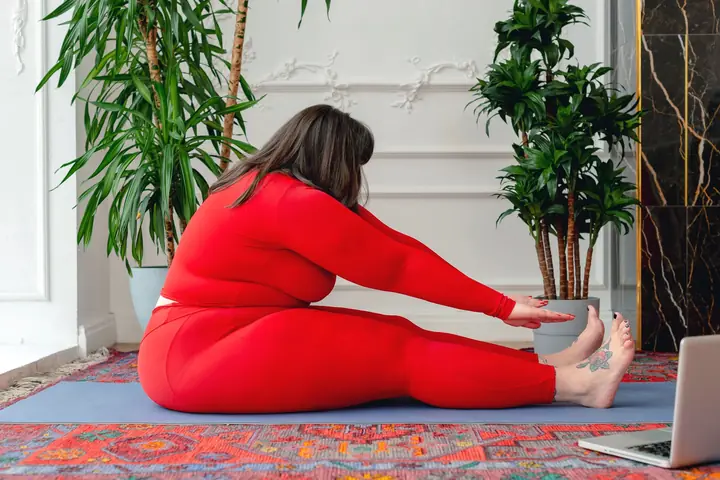
Seated Forward Fold
Sit on a folded blanket and fold forward from the hips in Seated Forward Fold for 60 seconds. Lead with your chest, not your head.
Use it
Finish with 5 standing leg lifts per side to train the new range actively.
For a longer version tied to running, see Yoga for Runners.
Hips
Low Lunge
Hold Low Lunge for 45 seconds per side with a cushion under the back knee. Tuck your tailbone slightly to feel the front of the back hip.
Lizard Pose
From the lunge, step the front foot wider and bring hands inside it for Lizard Pose, 30 seconds per side. Hands on blocks if the floor is far.
Figure Four
On your back, cross one ankle over the opposite knee for Figure Four, 60 seconds per side. This is the gentle version of Pigeon Pose.
Butterfly Pose
Sit up on a cushion with the soles of your feet together in Butterfly Pose for 60 seconds. Let the knees drop on their own.
The full Tight Hips Routine builds on this.
Shoulders and upper back
Cat-Cow
Do 8 rounds of Cat-Cow, letting the shoulder blades slide apart and together.
Thread the Needle
Hold Thread the Needle for 45 seconds per side, with a cushion under your head if your ear does not reach the floor.
Puppy Pose
Walk your hands forward with hips over knees in Puppy Pose for 45 seconds. Rest your forehead on a block.
Sphinx Pose
Prop up on your forearms in Sphinx Pose for 45 seconds to open the chest gently.
For desk-related stiffness, pair this with the Neck & Shoulder Release or a midday Desk Break Routine.