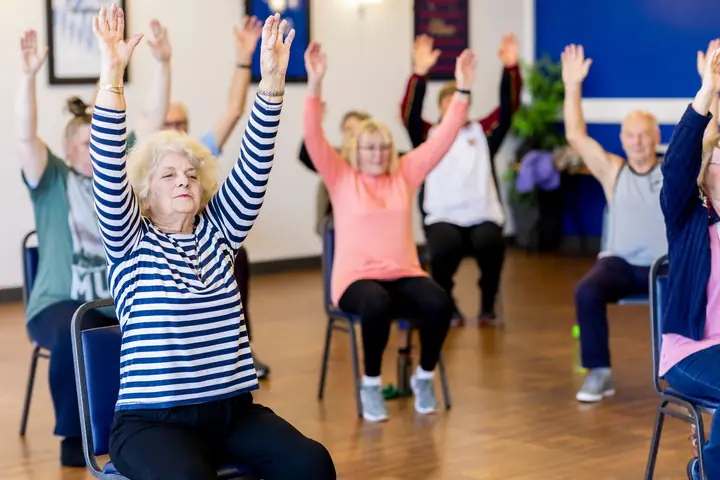
Quick take
- For older adults, anyone who finds the floor hard to get down to or up from, people recovering mobility, and office workers who want to stretch in their work clothes.
- You will feel looser through the spine, shoulders, neck and hips, and a little steadier on your feet after the standing balance work.
- Any time of day. Many people like it mid-morning or after a long stretch of sitting.
Choosing and setting up the chair
Use a solid, four-legged chair with a flat seat and a straight back: a dining or kitchen chair is ideal. Avoid anything with wheels, a swivel, a rocking base or a soft, sinking cushion. Armless chairs give your arms more room, but arms are fine if that is what you have.
Put the chair on a non-slip surface, or against a wall so it cannot slide back. Sit toward the front half of the seat with your feet flat on the floor, about hip-width apart, knees roughly over your ankles. If your feet do not reach the floor, rest them on a thick book or a firm cushion. For the two standing steps, you will stand behind the chair and hold its back.
The routine
Twelve steps of one minute each. Move slowly and breathe through your nose if you can. Every movement should feel comfortable; small is fine.
- Seated Breathing 1 min Sit tall near the front of the chair, feet flat, hands resting on your thighs. Breathe in for a count of four and out for a count of six.
- Seated Cat-Cow 1 min Hands on your knees: inhale, lift the chest and draw the shoulders back; exhale, round the back and let your chin drop. Keep it smooth and slow.
- Seated Neck Stretch 30 sec each side Tip your right ear toward your right shoulder and hold the side of the chair seat with your left hand to keep that shoulder down. Breathe into the side of the neck, then switch.
- Seated Side Bend 30 sec each side Left hand on the seat beside you, right arm up and over toward the left. Keep both sit bones pressing into the chair; if the arm feels heavy, rest the hand on your head.
- Seated Twist 30 sec each side Sit tall, then turn your chest to the right, right hand on the chair back and left hand on your right knee. Grow taller as you inhale, turn a touch more as you exhale, never forcing with the arms.
- Seated Hamstring Stretch 30 sec each side Slide one foot forward with the heel on the floor and toes up, knee straight or nearly straight. Keep your back long and hinge forward from the hips until you feel the back of that thigh.
- Seated Figure Four 30 sec each side Rest your right ankle on your left knee, or just cross at the ankles if that is too much. Sit tall, then lean forward slightly to feel the outer right hip.
- Seated Warrior Two 30 sec each side Turn to sit sideways on the chair with your right thigh resting on the seat and slide your left leg back, foot flat. Stretch your arms out to the sides, look over your right hand and press both feet into the floor.
- Mountain Pose with Chair 1 min Stand behind the chair holding its back with both hands, feet hip-width. Rise onto the balls of your feet and lower slowly ten times; to stay seated, lift and lower your heels from the chair instead.
- Tree Pose with Chair 30 sec each side Holding the chair back with one or both hands, rest one heel against the opposite ankle with toes on the floor. Seated option: lift one foot a few inches off the floor and hold, sitting tall.
- Seated Forward Fold 1 min Sit down, feet wider than your hips, and fold slowly forward, letting your arms hang or rest on your thighs. Come back up slowly, head last, especially if you tend to get dizzy.
- Seated Rest 1 min Sit back against the chair, hands in your lap, eyes closed or gaze down. Let your breath return to its own rhythm.
Why these poses
The routine starts with breathing and Cat-Cow because they warm up the spine in its easiest directions, forward and back. The neck stretch comes early, while the upper body is still relaxed, so it does not get rushed at the end.
Side bends and twists then move the spine in the directions people use less often in daily life. Turning to look over your shoulder when reversing a car, or reaching across a table, both rely on this kind of movement.
The middle steps move to the legs and hips: the back of the thighs, the outer hips and, in the seated warrior, the front of the back hip. These are the areas that tighten most with sitting, and you can stretch them well without leaving the chair.
The two standing steps train balance and ankle strength while the chair keeps you safe. Balance tends to decline with age and inactivity, and practicing it regularly in a controlled way can help you feel steadier. The routine then winds down with a fold and a seated rest so your heart rate and breathing settle before you get up.
Make it easier or harder
Easier
- Stay seated the whole time. Each standing step has a seated option in its cue.
- Make the movements smaller. A twist of a few inches still moves the spine.
- Skip the forward fold if bending forward makes you lightheaded, and do two minutes of seated breathing instead.
Harder
- Hold the chair with one finger, or let go for a few seconds, in Tree Pose.
- Add a sit-to-stand: five times, stand up from the chair without using your hands and sit back down slowly.
- Raise the arms overhead in Seated Cat-Cow on each inhale.
Questions
Is chair yoga real exercise?
It is gentle exercise. It works on flexibility, posture, breathing and balance rather than fitness or strength. For many people, especially those starting from very little activity, it is a sensible and useful place to start.
Can I do this at my desk?
Yes, as long as the chair does not roll. If your office chair has wheels, lock them if possible, or do the standing steps beside your desk holding its edge, and skip the side-sitting warrior.
How often should I do it?
Daily if you like. It is gentle enough for every day, and short sessions done often tend to help more than one long session a week.
I use a wheelchair. Can I follow this?
Most of the upper-body steps work in a wheelchair with the brakes on. Replace the standing steps with seated breathing or shoulder rolls, and adapt the leg steps to what you can do comfortably.