Quick take
- Rest for 3 to 10 minutes at the end of every session. Even 2 minutes is worth keeping.
- Get warm and supported first: something under your knees, something under your head, a layer on top.
- If you fall asleep, your body probably needed it. If you want to stay awake, rest with your knees bent or your eyes slightly open.
Why rest at the end
After moving and stretching, a few minutes of stillness gives your breathing and heart rate time to settle. Many people find this is when they first notice how their body feels: warmer, heavier, less tight in the places they just stretched.
Rest is also practice in doing nothing on purpose, which is harder than it sounds. Learning to lie still and let your attention rest on your body is a skill. It gets easier the more often you do it, and it carries over into falling asleep and handling stressful moments.
There is research suggesting that relaxation practices, including guided rest and body scans, can help with feelings of stress and with sleep quality for some people. The studies vary in quality, so treat it as a pleasant habit with likely benefits rather than a guaranteed fix.
Corpse Pose, done well
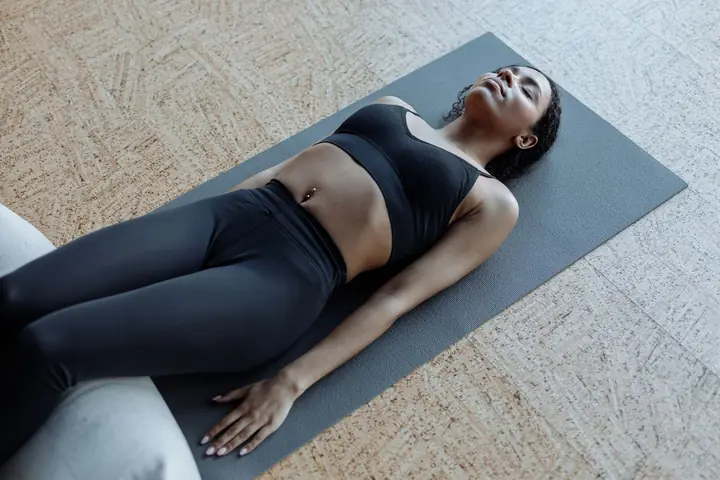
Corpse Pose looks like simply lying down. The difference between restless and restful is mostly in the setup.
Get warm
Your body cools quickly when you stop moving. Put on socks and a sweater, or lay a blanket over yourself before you lie down. Being cold is the most common reason people cannot settle.
Support your knees
Slide a rolled blanket or a firm cushion under your knees. This lets the lower back relax toward the floor. If your back is sensitive, bend your knees and rest the feet wide with knees leaning together.
Support your head
Put a thin folded blanket under your head so your chin is level or slightly down, not tipped up toward the ceiling.
Arrange your limbs
Let your feet fall open. Rest your arms a little away from your sides with palms up, or rest your hands on your belly if that is more comfortable for your shoulders.
Cover your eyes
A folded cloth or eye pillow over your eyes blocks light and helps many people relax faster.
Stop adjusting
Take one last wriggle to get comfortable, then commit to stillness. Let your breath go back to normal without controlling it.
If lying flat is uncomfortable, rest on your side with a cushion between your knees and another under your head. In later pregnancy, side lying is the usual recommendation.
A guided body scan
A body scan moves your attention slowly through your body, one area at a time. You are not trying to change anything, only to notice. Read through it once, then try it from memory, or record yourself reading it slowly.
Settle (1 minute)
Lie in Corpse Pose. Take three slow breaths with a long exhale, then let the breath find its own rhythm. Feel the weight of your body on the floor.
Feet and legs (1 to 2 minutes)
Bring your attention to your toes. Notice temperature, contact with the blanket, any tingling or nothing at all. Move to the soles, heels and ankles, then up through the calves, knees and thighs. Let each area feel heavy.
Hips and lower back (1 minute)
Notice where your pelvis meets the floor. Notice your lower back. If there is tightness, let it be there and breathe toward it.
Belly and chest (1 minute)
Feel your belly rise and fall. Notice your ribs widen and soften. You do not need to deepen the breath; just watch it.
Hands and arms (1 minute)
Move attention to your fingertips, palms and backs of the hands, then your wrists, forearms, elbows and upper arms. Let the hands go loose.
Shoulders, neck and face (1 to 2 minutes)
Notice your shoulders and let them widen. Soften the back of the neck. Unclench your jaw so your teeth part slightly. Relax your tongue, cheeks, eyes and forehead.
Whole body (1 minute)
Now feel the whole body at once, lying there and breathing. When your mind wanders, which it will, notice where it went and come back to the feeling of the whole body.
The full scan takes 7 to 10 minutes. For a shorter version, do feet, belly, hands and face, about 30 seconds each.
Yoga nidra-style rest
Yoga nidra is a form of guided rest usually done lying down, led by a voice. It often runs 20 to 40 minutes. A typical session includes settling in, a short personal intention, a slow body scan that moves through many small areas quickly, attention to breathing, pairs of opposite sensations (heavy and light, warm and cool), and a gradual return.
The aim is to stay in a deeply relaxed state while remaining slightly aware. You can try a simple version yourself:
Settle
Set up Corpse Pose as above and take a few slow breaths.
Pick a short phrase
Choose a plain, positive sentence in the present tense, such as "I am rested" or "I can handle today." Repeat it silently three times.
Quick scan
Name body parts silently, spending one breath on each: right thumb, index finger, middle finger, and so on, through the right side, then the left, then the back and front of the body.
Opposites
Imagine your body feeling very heavy, sinking into the floor, for a few breaths. Then very light. Then warm, then cool. Do not worry if this feels vague.
Return
Repeat your phrase three times. Notice the room and sounds around you, wiggle your fingers and toes, and come up slowly.
Many free recordings are available online if you prefer to be guided. Choose one that sounds calm and plain to you.
Legs Up the Wall
Legs Up the Wall is a restful alternative to Corpse Pose, and many people find it the most relaxing pose of all. It gently stretches the hamstrings and lets tired legs rest.
Get in
Sit sideways with one hip touching the wall. Lie back and swing both legs up the wall as you turn. Shuffle your hips toward the wall until your legs are comfortable.
Adjust
If your hamstrings pull, move your hips 15 to 30 cm (6 to 12 in) away from the wall and let your knees bend slightly. A folded blanket under your hips is optional.
Rest
Stay for 3 to 10 minutes, arms out to the sides. If your feet tingle, bend your knees and put the soles together against the wall for a few breaths.
Come out
Bend your knees, roll to one side and rest there for a few breaths before sitting up.
When you fall asleep
Dozing off during rest is very common, especially if you are short on sleep. It is not a failure. It usually tells you that you are tired.
If you want to stay awake, a few small changes help: rest with your knees bent and feet on the floor, keep your eyes slightly open and looking at one spot on the ceiling, rest with your palms on your belly so you feel each breath, or do the body scan, which gives your mind a task.
If you practice at a time when you have to be alert afterward, set a gentle timer for 5 or 10 minutes. When you come out of rest, roll to your side first and stay there for 3 breaths before sitting up. Getting up too quickly can make you lightheaded.
Using rest for sleep
The same tools can help you fall asleep. Do a short, gentle practice such as the Bedtime Wind-Down 30 to 60 minutes before bed, with the lights low. Then, in bed, lie on your back or side and do the body scan or the longer-exhale breath from Breathing Basics.
Keep it boring and predictable. The same short routine at the same time each night tends to work better than an elaborate one you do occasionally. If you wake in the night, a slow scan from your feet up gives your mind something calm to hold onto.
If sleep problems last more than a few weeks, or you snore loudly and wake unrefreshed, talk to a doctor. Relaxation can help with ordinary trouble falling asleep, but it is not a treatment for sleep disorders.