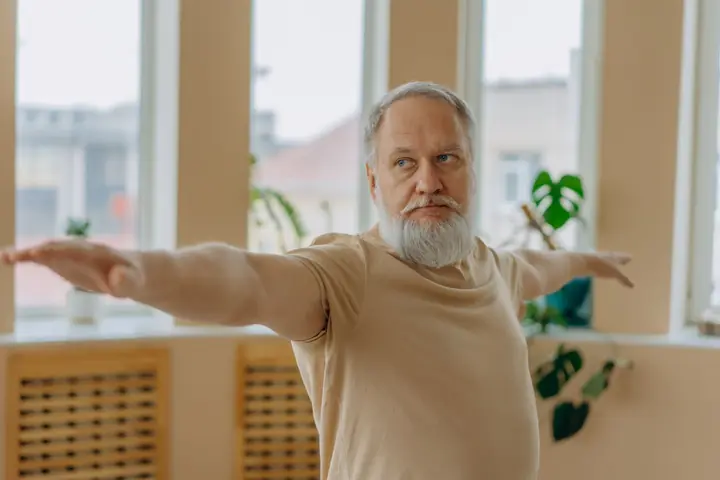
Mountain Pose
Tadasana
StandingBeginner5–8 breaths
A deliberate way of standing still that sets up every other standing pose. You should feel evenly balanced over both feet, with your legs working lightly and your spine tall without strain.
- Stand with your feet hip-width apart and parallel, second toes pointing straight ahead.
- Press down through the heel, the base of the big toe and the base of the little toe so the arches lift a little.
- Lift your kneecaps by gently tightening the front of the thighs, without locking the knees back.
- Stack your ribs over your pelvis, let the shoulders settle down and back, and lengthen the back of the neck.
- Rest your arms by your sides, palms forward, and breathe slowly through your nose.
Easier: Stand with your back a few inches from a wall and touch it lightly with your fingertips for balance and feedback.
Careful if: you feel dizzy standing still for long, which can happen with low blood pressure; keep your knees soft and shift your weight gently.
Used in: 10-Minute Morning Routine, Desk Break Routine, Chair Yoga
Standing Forward Fold
Uttanasana
StandingBeginner5–10 breaths
You hinge forward from the hips and let your upper body hang over your legs. Expect a stretch along the hamstrings and calves and a passive lengthening in the lower back.
- From Mountain Pose, put your hands on your hips and fold forward by tipping the pelvis, keeping your back long for the first half of the movement.
- Bend your knees as much as you need to rest your belly near your thighs.
- Let your head hang heavy so the neck is relaxed, and hold opposite elbows or rest your hands on the floor or blocks.
- Shift your weight slightly toward the balls of your feet so your hips stack over your ankles.
- To come up, bend your knees, put your hands on your thighs and roll up slowly, head last.
Easier: Keep a generous bend in the knees and rest your forearms on a chair seat or your hands on your shins.
Careful if: you have glaucoma, uncontrolled high blood pressure or a recent disc injury; fold only halfway with hands on a chair, and rise slowly if you get lightheaded.
Used in: 10-Minute Morning Routine, Yoga for Runners
Halfway Lift
Ardha Uttanasana
StandingBeginner2–5 breaths
A flat-back half fold that you usually move into from Standing Forward Fold. It teaches you to hinge at the hips with a long spine and wakes up the muscles along your back.
- From a forward fold, slide your hands to your shins or thighs, wherever your back can be flat.
- Lift your chest forward until your spine is roughly parallel to the floor, or a little higher.
- Draw your shoulder blades back toward your hips and keep your neck in line, eyes on the floor a foot or two ahead.
- Press your hands lightly into your legs as if you were pushing them away, which helps lengthen the spine.
- Soften your knees if your lower back rounds; a flat back matters more than straight legs.
Easier: Put your hands on blocks, a chair seat or the edge of a table at hip height.
Careful if: you have an acute lower back flare-up; keep your hands high on your thighs and your knees well bent.
Used in: 10-Minute Morning Routine
Low Lunge
Anjaneyasana
Kneeling lungeBeginner30–60 sec each side
A lunge with your back knee on the floor, which opens the front of the back hip and thigh. If you sit a lot, this is often where you feel the hip flexors most clearly.
- Step your right foot forward between your hands and lower your left knee to the mat, with padding under it.
- Stack your front knee over or just behind your front ankle.
- Lift your torso upright and rest your hands on your front thigh or hips.
- Gently tuck your tailbone down and draw your lower belly in; the stretch should move to the front of the left hip.
- Only then shift your hips forward an inch or two, and stop where the stretch is strong but easy to breathe through.
Easier: Fold a blanket under the back knee and keep your hands on blocks either side of the front foot.
Careful if: kneeling hurts your knee; add more padding or do the same stretch standing, holding a chair, with the back heel lifted.
Used in: 10-Minute Morning Routine, Tight Hips Routine, Yoga for Runners
High Lunge
Ashta Chandrasana
StandingIntermediate5–8 breaths each side
A standing lunge with the back heel lifted and the back knee off the floor. It builds strength in the front thigh and glutes, stretches the back hip and asks your core to keep you steady.
- From a low lunge, tuck the back toes and lift the back knee, pressing back through the heel.
- Keep your feet roughly hip-width apart side to side, as if on two rails, for better balance.
- Bend the front knee toward 90 degrees with the knee tracking over the middle toes.
- Lift your torso over your hips, ribs drawing in, and reach your arms up shoulder-width apart.
- Keep a slight bend in the back knee if your lower back starts to arch.
Easier: Lower the back knee to the floor, or keep your hands on your hips or on blocks instead of overhead.
Careful if: you have shoulder pain when lifting the arms, or knee pain in the front leg; shorten the stance and lower your hands.
Used in: 10-Minute Morning Routine, Core & Strength Flow
Warrior Two
Virabhadrasana II
StandingBeginner5–8 breaths each side
A wide standing pose with the front knee bent and the arms stretched out to the sides. It builds endurance in the thighs and opens the inner thighs and hips.
- Step your feet about one leg-length apart, front toes pointing forward and back foot turned in slightly.
- Line up your front heel roughly with the arch of your back foot.
- Bend the front knee until it sits over the ankle, and keep pressing it toward your little-toe side so it does not drift inward.
- Keep your torso upright over your hips, arms at shoulder height, shoulders relaxed down.
- Look past your front middle finger and press firmly through the outer edge of the back foot.
Easier: Shorten the stance and bend the front knee less, or rest your hands on your hips.
Careful if: your front knee aches; check that it is not past your toes or collapsing inward, and reduce the bend.
Used in: 10-Minute Morning Routine, Chair Yoga, Core & Strength Flow
Triangle Pose
Utthita Trikonasana
StandingBeginner5 breaths each side
A straight-legged side reach that tilts your torso over the front leg. It stretches the hamstrings, inner thighs and side body, and the side waist muscles work to hold you up.
- Take the same stance as Warrior Two but with both legs straight, front toes forward and back foot turned in slightly.
- Reach your front arm forward over the front leg, sliding your hips back, then tip the arm down.
- Rest the lower hand on your shin, a block or a chair, never pressing directly into the knee.
- Stack the top shoulder over the bottom one and reach the top arm to the ceiling.
- Keep a micro-bend in the front knee so the stretch stays in the muscle and not the back of the joint.
Easier: Put a block on its tallest side outside your front foot, or practice with your back against a wall.
Careful if: you have neck pain; look straight ahead or down at the floor instead of up at the top hand.
Chair Pose
Utkatasana
StandingBeginner3–6 breaths
A partial squat with your hips sitting back as if onto an invisible chair. It is a quick strength builder: thighs, glutes and the muscles along your back all work, and you will feel warm fast.
- Stand with your feet hip-width apart or touching, whichever feels more stable.
- Bend your knees and sit your hips back until you can still see your toes past your knees.
- Shift your weight into your heels and keep the knees pointing over the middle of the feet.
- Lean your chest slightly forward with a long spine and reach your arms up alongside your ears.
- Draw your lower ribs in so your back does not arch.
Easier: Sit back less deeply, keep your hands on your thighs or at your chest, or hover above an actual chair.
Careful if: you have knee pain on bending; keep the squat shallow and stop if the pain sharpens.
Used in: 10-Minute Morning Routine, Desk Break Routine, Core & Strength Flow
Goddess Pose
Utkata Konasana
StandingBeginner5–8 breaths
A wide-legged squat with the toes turned out. It strengthens the thighs and glutes and gives a stretch to the inner thighs and groin.
- Step your feet wide, about three to four feet apart, and turn your toes out about 45 degrees.
- Bend your knees and lower your hips toward knee height, keeping the knees pointing in the same direction as the toes.
- Stack your shoulders over your hips with your tailbone pointing down.
- Bend your elbows to 90 degrees with palms forward, or bring your hands together at your chest.
- Press the knees gently outward as you breathe so they stay over your ankles.
Easier: Bend your knees less and rest your hands on your thighs.
Careful if: your knees roll inward or hurt; turn the toes out less and narrow the stance.
Used in: Core & Strength Flow
Tree Pose
Vrksasana
StandingBeginner5–8 breaths each side
A one-legged balance with the other foot resting on the standing leg. It trains balance and the small muscles of the standing foot and hip, and opens the hip of the lifted leg.
- Shift your weight into your left foot and fix your eyes on one still point at eye level.
- Turn your right knee out and place the right sole on your left ankle, calf or inner thigh, anywhere except directly on the knee.
- Press the foot and the standing leg into each other so both stay steady.
- Keep your hips level and your standing knee straight but not locked.
- Bring your hands to your chest or reach them up, and switch sides after the same number of breaths.
Easier: Rest your toes on the floor with the heel against the ankle, and stand beside a wall to touch it lightly.
Careful if: you are prone to falls; always practice next to a wall or a sturdy chair.
Used in: 10-Minute Morning Routine, Chair Yoga, Core & Strength Flow
Cat-Cow
Marjaryasana-Bitilasana
All foursBeginner5–10 rounds
A slow, breath-led movement between arching and rounding your spine on hands and knees. It is a gentle way to move every part of the back and usually feels good after sleep or sitting.
- Set your hands under your shoulders and your knees under your hips, with the tops of the feet flat.
- Inhale: let your belly drop, lift your tailbone and chest, and look slightly forward.
- Exhale: press the floor away, round your back toward the ceiling and let your head hang.
- Start each movement from the pelvis and let it ripple up the spine to the head.
- Move at the speed of your breath and keep the range comfortable.
Easier: Pad your knees with a folded blanket, or do the same movement seated with hands on your knees.
Careful if: you have wrist pain; make fists or put your forearms on a cushion, and keep the arch small if your lower back is irritated.
Used in: 10-Minute Morning Routine, Desk Break Routine, Lower Back Relief, Neck & Shoulder Release, Tight Hips Routine, Yoga for Runners, Chair Yoga, Core & Strength Flow, Stress Reset
Child's Pose
Balasana
KneelingBeginner30 sec–3 min
A folded resting shape with your hips back toward your heels and your forehead down. You may feel a mild stretch in the lower back, hips and shoulders, and it is the default pose to rest in at any point.
- From all fours, bring your big toes together and widen your knees to about mat width.
- Sit your hips back toward your heels and lower your chest between your thighs.
- Rest your forehead on the mat, a block or your stacked fists.
- Stretch your arms forward for more shoulder stretch, or lay them by your sides for more rest.
- Breathe into your back ribs and feel them widen with each inhale.
Easier: Put a cushion between your hips and heels, or rest your chest on a pillow lengthwise.
Careful if: deep knee bending hurts; put a rolled blanket behind the knees or rest on your back instead.
Used in: Bedtime Wind-Down, Lower Back Relief, Neck & Shoulder Release, Core & Strength Flow, Stress Reset
Downward-Facing Dog
Adho Mukha Svanasana
Hands and feetBeginner5–10 breaths
An upside-down V shape with your hips high and your hands and feet on the floor. It stretches the hamstrings, calves and shoulders and builds strength in the arms.
- Start on all fours with your hands slightly ahead of your shoulders, fingers spread wide.
- Tuck your toes, lift your knees and send your hips up and back.
- Keep your knees bent at first so your spine can lengthen from hands to hips.
- Press the floor away with your whole hand, especially the base of the index finger, and let your head hang between your upper arms.
- Once the back is long, pedal your feet or lower your heels gradually; they do not need to touch the floor.
Easier: Do it with your hands on a wall or a table so your hips stay level with your shoulders.
Careful if: you have wrist or shoulder pain, glaucoma or uncontrolled high blood pressure; use the wall version or skip it.
Used in: 10-Minute Morning Routine, Tight Hips Routine, Yoga for Runners, Core & Strength Flow
Plank Pose
Phalakasana
Hands and toesIntermediate15–45 sec
The top of a push-up, held still. It works the abdominals, shoulders, chest and the front of the thighs together.
- From all fours, step your feet back one at a time until your body forms one line from head to heels.
- Stack your shoulders directly over your wrists.
- Push the floor away so your upper back does not sag between your shoulder blades.
- Draw your lower belly in and tighten your thighs so your hips stay level, neither high nor sinking.
- Keep your neck long and look at the floor just ahead of your hands.
Easier: Lower your knees to the mat and keep the line from head to knees, or do it with your hands on a counter.
Careful if: your wrists hurt or your lower back starts to ache; drop to your knees or forearms and shorten the hold.
Used in: Core & Strength Flow
Puppy Pose
Uttana Shishosana
KneelingBeginner30–60 sec
A cross between Child's Pose and Downward Dog with your hips over your knees and your chest sinking toward the floor. Expect a strong stretch through the shoulders, armpits and upper back.
- Start on all fours, then walk your hands forward a few hand lengths.
- Keep your hips stacked over your knees as you lower your chest toward the mat.
- Rest your forehead or chin on the floor or a block.
- Keep your arms shoulder-width apart and your elbows lifted off the floor.
- Let your upper back soften toward the floor without forcing the arch in your lower back.
Easier: Rest your forearms on a block or bolster, or do the same shape standing with your hands on a wall.
Careful if: you have a shoulder injury or a history of dislocation; keep the hands closer and the stretch light.
Used in: 10-Minute Morning Routine, Neck & Shoulder Release
Thread the Needle
All foursBeginner30–60 sec each side
A kneeling twist where one arm slides under your body and the shoulder rests on the floor. It stretches the back of the shoulder and the upper back, a common spot for desk tension.
- Start on all fours with your hips over your knees.
- Inhale and reach your right arm up toward the ceiling, opening your chest.
- Exhale and slide the right arm under your left arm, palm up, until your right shoulder and ear rest on the mat.
- Keep your hips over your knees so the twist stays in the upper back.
- Press lightly into the left hand to tune the stretch, then return the same way and switch sides.
Easier: Put a block or cushion under your head so the shoulder does not have to reach the floor.
Careful if: you have neck pain; make sure your head is supported and turn it only as far as is comfortable.
Used in: 10-Minute Morning Routine, Neck & Shoulder Release, Stress Reset
Bird-Dog
All foursBeginner6–10 slow reps each side
An all-fours balance where you reach the opposite arm and leg away from each other. It trains the deep trunk and back muscles to keep your spine steady while your limbs move.
- Set your hands under your shoulders and knees under your hips, with your back flat like a tabletop.
- Brace your belly lightly, as if about to be poked, without holding your breath.
- Slide your right leg back and lift it to hip height while you reach your left arm forward to shoulder height.
- Keep both hips level and pointing at the floor; imagine a glass of water on your lower back.
- Hold for two breaths, return slowly and switch sides.
Easier: Move only the leg or only the arm, or slide the foot back along the floor without lifting it.
Careful if: your lower back arches as the leg lifts; lower the leg until your back stays flat.
Used in: Lower Back Relief, Core & Strength Flow
Lizard Pose
Utthan Pristhasana
Kneeling lungeIntermediate30–60 sec each side
A deep, low lunge with your front foot stepped toward the outside edge of the mat and both hands inside it. It stretches the hip flexors of the back leg and the groin and inner hip of the front leg.
- From all fours, step your right foot outside your right hand, toes pointing forward or slightly out.
- Lower the left knee to a padded mat and slide it back until you feel the stretch.
- Keep your front knee over the ankle and let it fall slightly to the outside.
- Stay on your hands, or lower your forearms to a block or the floor if your hips allow.
- Keep your chest moving forward so your back stays long, then repeat on the other side.
Easier: Stay on your hands with blocks under them and a folded blanket under the back knee.
Careful if: you feel a pinch at the front of the front hip; lift your chest and step the foot slightly wider.
Used in: Tight Hips Routine, Yoga for Runners
Cobra Pose
Bhujangasana
Lying on bellyBeginner3–5 breaths, 2–3 times
A gentle backbend from lying on your belly, lifting your chest with your back muscles and a little help from your hands. It strengthens the back extensors and opens the chest and the front of the body.
- Lie face down with your legs hip-width apart and the tops of your feet pressing into the mat.
- Place your hands under your shoulders, elbows tucked against your ribs.
- Inhale and lift your head and chest, using your back first and your hands second.
- Keep your elbows bent and your shoulders drawn away from your ears.
- Rise only as high as is comfortable for your lower back, then lower slowly on an exhale.
Easier: Make it a baby cobra: lift just a few inches with your hands hovering off the floor, or use Sphinx Pose.
Careful if: backbends increase your back pain or you have spinal stenosis; keep the lift tiny or skip it.
Sphinx Pose
Salamba Bhujangasana
Lying on bellyBeginner1–3 min
A supported backbend propped on your forearms. It is milder than Cobra and comfortable to hold for longer, giving a gentle extension to the lower back and an opening across the chest.
- Lie on your belly and place your elbows slightly in front of your shoulders, forearms parallel.
- Press your forearms down and gently draw them back toward you to lift and broaden the chest.
- Let your legs and glutes relax and your belly rest heavy on the floor.
- Keep the back of the neck long and gaze forward or slightly down.
Easier: Slide your elbows further forward to reduce the curve, or put a folded blanket under your hips.
Careful if: you feel compression or pinching in the lower back; move the elbows forward or come down.
Used in: Lower Back Relief, Neck & Shoulder Release
Locust Pose
Salabhasana
Lying on bellyIntermediate3–5 breaths, 2–3 times
A belly-down backbend where you lift your chest, arms and legs off the floor without using your hands. It strengthens the entire back of the body: upper back, lower back, glutes and hamstrings.
- Lie face down with your arms by your sides, palms down, and your forehead on the mat.
- Press the tops of your feet and your pubic bone into the floor for a moment to set your pelvis.
- Inhale and lift your head, chest and arms, reaching your fingertips back toward your feet.
- Lift your legs a few inches, keeping them straight and about hip-width.
- Keep your gaze on the floor slightly ahead so your neck stays long, then lower on an exhale.
Easier: Lift only the upper body or only the legs, or alternate one leg at a time.
Careful if: you have lower back pain that worsens with arching, or are pregnant; choose Bird-Dog instead.
Used in: Neck & Shoulder Release, Core & Strength Flow
Bridge Pose
Setu Bandha Sarvangasana
Lying on backBeginner5–8 breaths, 2–3 times
Lying on your back with the knees bent, you lift your hips toward the ceiling. It strengthens the glutes and hamstrings and stretches the front of the hips and the chest.
- Lie on your back with knees bent and feet flat, hip-width apart, heels a hand's length from your hips.
- Rest your arms by your sides, palms down.
- Press through your heels and lift your hips until your body forms a line from knees to shoulders.
- Keep your knees pointing straight ahead; a block squeezed lightly between them helps.
- Keep your head still and looking straight up, then roll down one vertebra at a time.
Easier: Lift only a few inches, or rest your sacrum on a block placed on its lowest side for a supported version.
Careful if: you have neck pain; never turn your head while your hips are lifted, and keep the lift lower.
Used in: Lower Back Relief, Tight Hips Routine, Core & Strength Flow
Boat Pose
Navasana
Seated balanceIntermediate3–5 breaths, 2–3 times
A balance on your sit bones with your legs lifted and your chest tall. It works the abdominals and the hip flexors hard, so expect a burn quickly.
- Sit with your knees bent and feet flat, hands behind your thighs.
- Lean back slightly until you feel balanced on your sit bones, keeping your chest lifted and your back long.
- Lift your feet so your shins are parallel to the floor.
- Reach your arms forward at shoulder height, palms facing each other.
- Keep breathing; if your back starts to round, lower your feet.
Easier: Keep your hands behind your thighs and your toes touching the floor.
Careful if: you have lower back pain, osteoporosis or are pregnant; choose Bird-Dog or Plank on your knees instead.
Used in: Core & Strength Flow
Easy Seat
Sukhasana
SeatedBeginner1–5 min
A simple cross-legged seat for breathing, resting or starting a practice. The goal is a tall, relaxed spine, and for most people the cushion under the hips makes all the difference.
- Sit on the edge of a folded blanket or cushion so your hips are higher than your knees.
- Cross your shins loosely, each foot under the opposite knee.
- Rock side to side to find the front of your sit bones, then stack your ribs over your pelvis.
- Rest your hands on your thighs and let your shoulders drop.
- Switch which shin is in front every time you sit.
Easier: Sit higher, put cushions under your knees, or sit on a chair with both feet flat.
Careful if: your knees or hips ache; raise the seat and support the knees, or sit in a chair.
Used in: 10-Minute Morning Routine, Bedtime Wind-Down, Neck & Shoulder Release, Tight Hips Routine, Chair Yoga, Stress Reset
Butterfly Pose
Baddha Konasana
SeatedBeginner1–2 min
A seated pose with the soles of your feet together and your knees falling out to the sides. It stretches the inner thighs and groin and is a gentle way to open the hips.
- Sit on a folded blanket and bring the soles of your feet together, knees out wide.
- Slide the feet closer for more inner thigh stretch, or further away for a gentler one.
- Hold your ankles or shins and sit tall before you think about leaning forward.
- If you fold, hinge from the hips with a long back and let the knees drop without pushing them down.
Easier: Put blocks or cushions under your knees, or do it lying on your back.
Careful if: you have a groin strain or knee injury; support the knees and keep the feet further away.
Used in: Bedtime Wind-Down, Tight Hips Routine
Seated Forward Fold
Paschimottanasana
SeatedBeginner1–2 min
A seated fold over straight or bent legs. It stretches the hamstrings and the back of the body, and when held quietly it tends to feel calming.
- Sit on a folded blanket with your legs straight in front of you, toes pointing up.
- Inhale and lengthen your spine, reaching your arms up or resting your hands on your thighs.
- Exhale and fold forward from your hips, leading with your belly, not your head.
- Rest your hands where they land on your legs or feet, or use a strap around the soles.
- Stop when your back starts to round strongly and breathe there.
Easier: Bend your knees and put a rolled blanket under them, or rest your chest on a pillow on your thighs.
Careful if: you have a hamstring injury, sciatica or a disc problem; bend your knees well and keep the fold gentle.
Used in: Chair Yoga
Seated Side Bend
Parsva Sukhasana
SeatedBeginner3–5 breaths each side
A simple side stretch from a cross-legged seat, reaching one arm over your head. It lengthens the muscles along the side of the waist and back and the side of the ribs, a part that rarely moves in daily life.
- Sit in Easy Seat on a cushion and place your left hand on the floor beside your left hip.
- Inhale and reach your right arm up toward the ceiling.
- Exhale and arc your arm and torso to the left, keeping your right sit bone grounded.
- Keep your chest facing forward without twisting or collapsing toward the floor.
- Breathe into your right ribs, then return on an inhale and switch sides.
Easier: Keep the lifted hand on your head or hip, or do it in a chair.
Careful if: lifting the arm pinches your shoulder; keep the hand behind your head with the elbow bent.
Used in: Bedtime Wind-Down, Desk Break Routine, Neck & Shoulder Release, Chair Yoga
Seated Twist
Parivrtta Sukhasana
SeatedBeginner5 breaths each side
A gentle cross-legged twist that turns your ribs and upper back while your hips stay grounded. It is a simple way to move the spine through rotation after sitting.
- Sit tall in Easy Seat on a cushion.
- Inhale and lengthen your spine; exhale and turn to the right, right hand behind you and left hand on your right knee.
- Turn from your belly and ribs first, then shoulders, then head last.
- Keep both sit bones heavy and avoid pulling hard with the hand on your knee.
- With each inhale, grow taller; with each exhale, turn slightly more, then return to center and switch.
Easier: Sit sideways on a chair and hold the backrest, or twist without using your hands.
Careful if: you have a disc injury or osteoporosis; keep the twist small and avoid forcing it with your arms.
Used in: Bedtime Wind-Down, Desk Break Routine, Chair Yoga
Pigeon Pose
Eka Pada Rajakapotasana
Seated, hips squareIntermediate1–2 min each side
A deep hip opener with one shin angled across the front of your mat and the other leg stretched back. It stretches the outer hip and glutes of the front leg and the hip flexors of the back leg.
- From all fours, bring your right knee behind your right wrist and angle your right foot toward your left hip.
- Slide your left leg straight back, top of the foot down.
- Place a block or folded blanket under your right hip if it does not reach the floor, so your pelvis stays level.
- Keep your right foot flexed to protect the knee.
- Stay upright on your hands or fold forward onto your forearms or a cushion.
Easier: Do Figure-Four on your back, which stretches the same muscles without loading the knee.
Careful if: you feel any pain in the front knee; come out and use Figure-Four instead.
Used in: Tight Hips Routine, Yoga for Runners
Figure-Four
Lying on backBeginner1–2 min each side
A lying hip stretch where one ankle crosses the opposite knee and you draw your legs toward you. It targets the outer hip and glutes and is a knee-friendly alternative to Pigeon.
- Lie on your back with your knees bent and feet flat.
- Cross your right ankle over your left thigh, just above the knee, and flex your right foot.
- Lift your left foot and thread your right hand through the gap to hold behind your left thigh.
- Draw the legs toward your chest until you feel the stretch in your right hip.
- Keep your head and shoulders relaxed on the floor.
Easier: Keep your left foot on the floor or against a wall, and press your right knee gently away.
Careful if: you feel pain in the knee of the crossed leg; move the ankle further down the thigh.
Used in: Bedtime Wind-Down, Desk Break Routine, Lower Back Relief, Tight Hips Routine, Yoga for Runners, Chair Yoga
Reclined Hamstring Stretch
Supta Padangusthasana
Lying on backBeginner1 min each side
Lying on your back, you lift one leg toward the ceiling with a strap around the foot. It stretches the hamstrings and calf without straining your lower back, since the floor keeps your back supported.
- Lie on your back with your left knee bent, foot flat, or the left leg straight on the mat.
- Loop a strap or towel around the ball of your right foot.
- Straighten your right leg toward the ceiling, holding the strap with both hands.
- Keep your hips heavy and level on the floor.
- Find a moderate stretch and hold it; a slight knee bend is fine.
Easier: Keep the lifted leg slightly bent, or lie in a doorway and rest the leg against the frame.
Careful if: you feel tingling down the leg; reduce the stretch, since this can be the nerve rather than the muscle.
Used in: Lower Back Relief, Yoga for Runners
Knees to Chest
Apanasana
Lying on backBeginner30 sec–1 min
Lying on your back, you hug both knees in toward your chest. It gives a gentle stretch to the lower back and glutes and is a calming reset between harder poses.
- Lie on your back and draw both knees toward your chest.
- Hold your shins or the backs of your thighs.
- Let your shoulders and head rest on the floor.
- Rock gently side to side or make small circles with your knees to massage your lower back.
Easier: Hug one knee at a time with the other foot flat on the floor.
Careful if: you have knee pain; hold behind the thighs instead of on the shins.
Used in: Bedtime Wind-Down, Lower Back Relief, Stress Reset
Supine Twist
Supta Matsyendrasana
Lying on backBeginner1–2 min each side
Lying on your back, you let your bent knees fall to one side while your shoulders stay down. It is a passive twist that stretches the lower back, glutes and chest and works well at the end of a session.
- Lie on your back with your knees bent and feet flat.
- Shift your hips a few inches to the right.
- Let your knees fall to the left and rest them on the floor or a cushion.
- Open your arms wide and let your right shoulder sink toward the floor.
- Turn your head to the right only if it feels good for your neck, then switch sides.
Easier: Put a pillow or block under your knees so they do not drop all the way.
Careful if: you have a disc problem or recent back injury; keep the twist small and supported.
Used in: Bedtime Wind-Down, Lower Back Relief, Tight Hips Routine, Yoga for Runners, Core & Strength Flow, Stress Reset
Happy Baby
Ananda Balasana
Lying on backBeginner30 sec–1 min
On your back, you hold your feet with your knees bent wide toward your armpits. It stretches the inner thighs, groin and lower back.
- Lie on your back and draw your knees toward your chest.
- Open your knees wider than your torso and stack your ankles over your knees.
- Hold the outside edges of your feet, your ankles or the backs of your knees.
- Gently pull your knees down toward the floor beside your ribs.
- Keep your tailbone and head on the floor and rock side to side if it feels good.
Easier: Hold your shins or use a strap around each foot.
Careful if: you have a groin strain or knee pain; hold behind the thighs instead.
Used in: Bedtime Wind-Down, Tight Hips Routine, Yoga for Runners
Legs Up the Wall
Viparita Karani
Lying on backBeginner3–10 min
You lie on your back with your legs resting straight up a wall. It gives a mild hamstring stretch and is one of the most restful poses at the end of the day.
- Sit sideways with one hip touching the wall.
- Swing your legs up the wall as you lower your back to the floor.
- Scoot your hips close to the wall, or back a few inches if your hamstrings pull.
- Rest your arms by your sides and let your legs be heavy.
- To come out, bend your knees, roll to one side and pause before you sit up.
Easier: Move further from the wall and bend your knees, or rest your calves on a chair seat.
Careful if: you have glaucoma or uncontrolled high blood pressure, or your feet start to tingle; rest your calves on a chair instead.
Used in: Bedtime Wind-Down, Yoga for Runners, Stress Reset
Corpse Pose
Savasana
Lying on backBeginner3–10 min
A final rest lying flat on your back with nothing to do. It gives your body and breath time to settle and is where most routines end.
- Lie on your back with your legs a little wider than your hips and your feet falling out.
- Rest your arms away from your sides, palms up.
- Tuck your chin slightly so the back of your neck is long.
- Let your breath return to normal and let each body part feel heavy.
- To finish, wiggle your fingers and toes, roll onto one side and press yourself up slowly.
Easier: Put a pillow under your knees for your lower back and a folded blanket under your head.
Careful if: lying flat on your back is uncomfortable, for example later in pregnancy; rest on your side with a pillow between your knees.
Used in: Bedtime Wind-Down, Lower Back Relief, Tight Hips Routine, Core & Strength Flow, Stress Reset
No poses match. Try another word.