Quick take
- For the end of a tense day, after a hard conversation, or whenever you notice tight shoulders, a clenched jaw and fast, shallow breathing.
- You should feel heavier, warmer and slower by the end. The stretches are mild; the breathing does most of the work.
- Evening is ideal, but it works any time you can lie down for ten minutes without interruption.
The routine
The one rule: breathe in through your nose for about four counts and out for about six. If six feels like a strain, breathe in for three and out for five. Let each pose follow the rhythm of your breath rather than a clock, and dim the lights if you can.
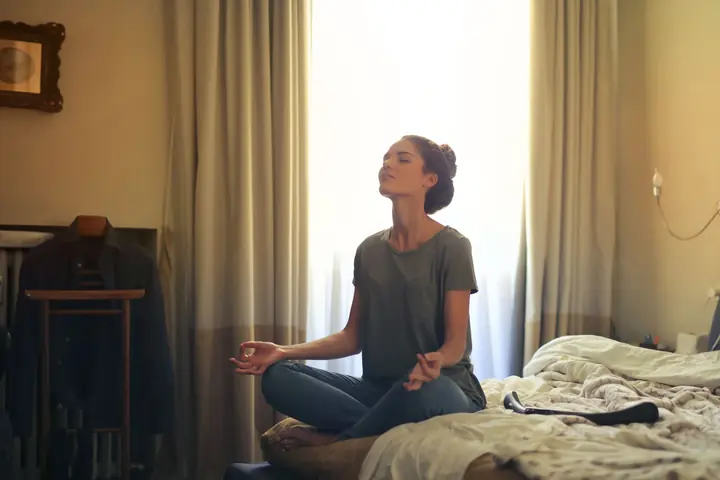
- Easy Seat 1.5 min Sit on a cushion with one hand on your chest and one on your belly. Breathe in for four, out for six, and let the belly hand rise more than the chest hand.
- Cat-Cow 1 min On hands and knees, take the slowest Cat-Cow you have ever done. Inhale to lift the chest, then let the exhale round your back all the way to the end of the breath.
- Child's Pose 1 min Knees wide, hips toward your heels, forehead on the mat or on your stacked fists. Feel your back expand against the breath as you inhale, and soften as you exhale.
- Thread the Needle 30 sec each side From hands and knees, slide one arm under the other and rest that shoulder and the side of your head on the mat. Let the exhale release the space between your shoulder blades.
- Knees to Chest 30 sec Roll onto your back and hug your knees in. Rock slowly side to side so your lower back gets a small massage from the floor.
- Supine Twist 30 sec each side Let your knees fall to one side and turn your head the other way if your neck allows. Relax your jaw and let each exhale drop the knees a little lower.
- Legs Up the Wall 2 min Hips close to the wall, legs resting up it, arms by your sides with palms up. Stretch your exhale out to eight counts if it comes easily, without straining.
- Corpse Pose 2 min Lie flat with a cushion under your knees. Stop counting and let your breath find its own pace; just notice the pause after each exhale.
Why these poses
Stress speeds up your breathing and makes it shallow. Slowing it down, and especially lengthening the exhale, is one of the simplest ways to tell your body it can stand down. Research on slow breathing suggests it can lower heart rate and help people feel calmer, though effects vary from person to person. This routine is built around that breath, with poses chosen so they never compete with it.
Easy Seat comes first so you can set the 4:6 rhythm while sitting still. Cat-Cow then pairs movement with breath, which helps when your mind is racing too much to sit quietly. Child's Pose and Thread the Needle are forward-folding and inward-facing, which many people find settling, and they release the upper back and shoulders, where stress often sits.
The second half is lying down. Knees to Chest and the twist ease the lower back. Legs Up the Wall and Corpse Pose ask nothing of your muscles at all, so the only thing left to do is breathe slowly and rest. Ending on stillness, rather than a stretch, gives your nervous system a few minutes to catch up with your body.
Getting the breath right
- Breathe low. Your belly and lower ribs should move more than your upper chest.
- Exhale gently. Longer does not mean forced. A soft, slow sigh through the nose or pursed lips is enough.
- Lose count? Start again at one. Wandering attention is normal and the counting is just a handrail.
- Feeling lightheaded? Go back to normal breathing for a minute. You may have been breathing too deeply rather than too slowly.
For more patterns and a visual pacer to follow, see Breathing Basics.
Make it easier or harder
- No wall? Lie on your back with your calves resting on the seat of a chair or sofa.
- Can't get to the floor? Do the breathing, Cat-Cow and twist seated in a chair, then rest with your feet up.
- Only three minutes? Do the Easy Seat breathing and Legs Up the Wall.
- Want longer? Double the time in Legs Up the Wall and Corpse Pose. The extra rest is where most of the calm builds.
Questions
Why make the exhale longer than the inhale?
Breathing out is linked with the part of the nervous system that slows the heart. A longer exhale, at a slow overall pace, is a simple way many people find calming. It also gives your attention something concrete to do.
Can I do this right before bed?
Yes. It works well as the last thing you do before getting into bed. For a slightly longer session aimed at sleep, try the Bedtime Wind-Down.
What if my mind keeps racing?
Expect it to. Each time you notice you have drifted, bring your attention back to counting the exhale. That noticing and returning is the practice itself.
Can I do it at work?
The breathing works anywhere. At a desk, sit tall, do two minutes of the 4:6 rhythm, and add a seated twist on each side. The Chair Yoga routine has more ideas.